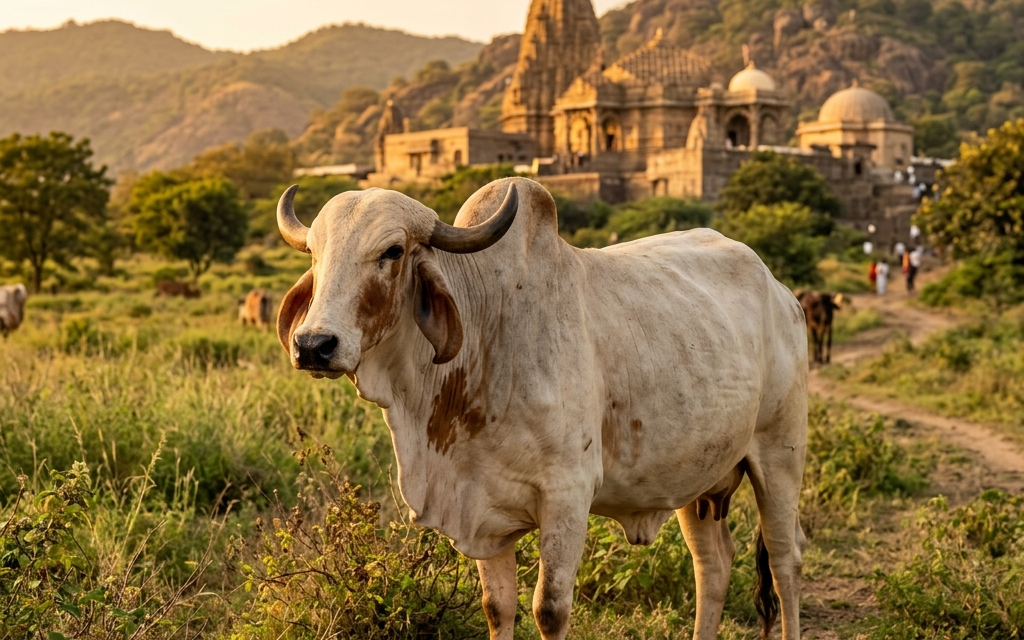
Gujarat’s Five Deshi Cows: Gir, Kankrej, Dangi, Nari, and Dagri
Gujarat is the westernmost expression of India’s great bovine civilisation. From the sacred forests of Kathiawar to the salt flats of the Rann of Kutch, from the rain-drenched hills of the Dangs to the tribal highlands bordering Rajasthan, this single state has produced five completely distinct indigenous cow breeds — each one a living record of the geography, community, and agricultural need that created her. Gujarat’s deshi cows are not merely livestock. Two of them helped build the American Brahman. One of them nurtured Lord Krishna. All of them are irreplaceable.
1. Gir — India’s Most Famous Milch Cow
No deshi breed carries a larger global footprint than the Gir. She originated in the Gir hills and forests of South Kathiawar and today her descendants number in the millions in Brazil, where they are bred for elite dairy production under the name *Gir Leiteiro*.
Gir cows are the finest milk producers among indigenous cattle. The breed is also known as “Bhodali”, “Desan”, “Gujarati”, “Kathiawari”, “Sorthi”, and “Surati”. The breeding tract includes the Saurashtra region of Gujarat. Gir is named after the Gir forest, the geographical area of origin. Bullocks can drag heavy loads on all kinds of soils — sandy, black, or rocky. This is a world-renowned breed known for its tolerance to stress conditions, its capacity to yield more milk with less feeding, and its resistance to various tropical diseases.
Her appearance is utterly distinctive and unlike any other breed in India. The horns are peculiarly curved — starting at the base of the crown, they take a sideways, downward, and backward curve, then incline upward and forward in a spiral inward sweep, ending in a fine taper, giving a half-moon appearance. Long and pendulous ears fold like a leaf, hanging all the time with their inside face forward. Her broad, domed, convex forehead is unlike any other bovine face on the subcontinent.
Average lactation yield of Gir cow is 2,110 kg, ranging from 800 to 3,300 kg, with an average milk fat of 4.6%. Her milk is A2 beta-casein protein milk — easier to digest, nutritionally richer, and increasingly sought after by health-conscious consumers globally. Due to their special qualities, animals of this breed have been imported by Brazil, the USA, Venezuela, and Mexico, and are being bred there successfully. In Brazil, the population was estimated at approximately five million in 2010. The Gir is Gujarat’s greatest gift to the world’s dairy gene pool.
2. Kankrej — The Ancient Giant with the Lyre Horns
If the Gir is Gujarat’s dairy queen, the Kankrej is her warrior king — one of the heaviest, most powerful, and most historically significant cattle breeds in all of India, with origins traceable to the Indus Valley Civilisation itself.
The Kankrej cow is found in the Rann of Kutch in Gujarat and the Barmer and Jodhpur districts in Rajasthan. It is also known as Wadad, Waged, and Wadhiar. It is used for both dairy and draught purposes. Kankrej cow colour is a distinct silver-grey to iron grey, with a prominent hump and lyre-shaped horns.
The Kankrej breed takes its name from Kankrej Taluka in Gujarat. It is one of the heaviest of the Indian breeds of cattle. Significant characteristics include resistance to tick fever, heat stress, very little incidence of contagious abortion and tuberculosis — qualities that made the Kankrej a very popular breed for export and breeding in foreign countries. The cows yield on average 1,738 kilograms of milk per single lactation.
Kankrej is India’s heaviest cow breed, known for its “Sawai Chal” — a fast, distinctive gait. It was used along with the Gir to develop the American Brahman in the USA. That two of Gujarat’s five breeds contributed to the creation of America’s most commercially important beef breed is a fact that rarely receives the recognition it deserves. The Kankrej bull’s combination of size, speed, and stamina makes him the ultimate heavy agricultural animal — capable of ploughing black cotton soil, hauling salt from the Rann, and trotting with loaded carts across the semi-arid landscape of Kutch.
3. Dangi — The Rain-Born Cow of the Ghats
Where the Gir belongs to the dry Saurashtra and the Kankrej to the arid Kutch, the Dangi belongs to a completely different Gujarat — the wet, forested, mountainous south, where the Western Ghats begin and where annual rainfall would drown most other cattle breeds. The Dangi evolved precisely to thrive where no other deshi cow can.
The breeding tract of the Dangi breed includes the Dangs district of Gujarat and the Thane, Nasik, and Ahmednagar districts of Maharashtra. Dangi cattle are extensively used for ploughing, harrowing, and other field operations, and for carting timber from forest areas. The breed is well known for its excellent working qualities in heavy rainfall areas, rice fields, and hilly tracts. The animals are adapted to heavy rainfall conditions. The skin exudes an oily secretion which protects them from heavy rain.
That oily skin secretion is not a minor detail — it is a remarkable biological adaptation, found in almost no other cattle breed on the subcontinent, making the Dangi virtually weatherproof. Dangi cattle have a distinct white coat colour with red or black spots distributed unevenly over the body. Horns are short and thick with laterally pointing tips.
The cattle of this breed are docile and have an energetic and vigorous appearance. The bullocks are utilized for all general agricultural work and are extensively used for paddy cultivation and road transport in the Ghat areas and the Konkan patti. As draught animals, they can cover 20 to 24 miles per day, carrying heavy timber at a rate of 2 to 3 miles per hour. The Dangi is built not for the dairy shed but for the forest trail — compact, sure-footed, rain-resistant, and tireless.
4. Nari — Child of the Aravallis
The Nari occupies the ecological borderland between Gujarat and Rajasthan, living in and around the Aravalli hill system where the two states meet. She has already been described in the context of Rajasthan’s deshi breeds, but she is equally Gujarat’s own — specifically of the Banaskantha and Sabarkantha districts that form Gujarat’s northeastern shoulder against the hills.
The breeding tract of the Nari includes the Banaskantha and Sabarkantha districts of Gujarat and the Pali and Sirohi districts of Rajasthan. The majority of the Nari cattle population is found surrounding the Aravalli forest range in slightly hilly and undulating terrain. The animals are adapted to the hot climate of the Aravalli foothills. Coat colour varies from white or greyish-white in the majority of cows, with bulls sometimes white, greyish-white, or black. Horns are spirally curved, outward-forward in orientation — long, thick at the base, and pointed at the tip. The forehead is broad and slightly concave.
The name “Nari” derives from the word “Nar”, meaning hills. The breed is also known as “Sirohi”. These are medium-sized animals with excellent migratory capacity and can survive on grazing and in open housing across all weather conditions. Average lactation yield is 1,647 kg. The Nari is valued for both moderate milk yield and strong draught performance across hilly and plain terrain — a true dual-purpose hill breed with an estimated population of only around 15,000 animals, making active conservation essential.
5. Dagri — The Tribal Cow of the Eastern Forests
The Dagri is Gujarat’s most recently recognized indigenous breed and its least known — a tribal cattle breed of the eastern border districts, maintained almost entirely by the Adivasi communities of the hills where Gujarat meets Madhya Pradesh and Rajasthan.
Dagri is a draught breed of Gujarat, also known as “Gujarat Malvi”. The term “Dagri” in colloquial language means “Deshi”, “old”, or “native”. The breeding tract includes Godhara/Panch Mahals, Dahod, Narmada, Chhotaudepur, and Mahisagar districts of Gujarat. Animals are small-sized with compact body, white in colour with sometimes a grey shade, and a body length proportionally more than height, with a straight forehead. Horns are short and thin, curved upward in a lyre shape or straight fashion with pointed tips. The animals are maintained in an extensive management system and taken to pastures during the day, maintained entirely on grazing. The average milk yield per lactation is 316 kg, ranging from 75 to 650 kg, with an average milk fat of 4.08%.
The Dagri is a draught-purpose breed used extensively for agricultural operations in hilly areas. Milk yield is less — 1.5 to 3.0 kg per day — mainly used for household consumption. Less feed requirement, survives mainly on grazing, and is hardly stall-fed. This lesser-known population of hilly cattle was not recognized or registered as a distinct breed before its formal investigation. As a result of conservation efforts, it is now recognized and registered as a new cattle breed with ICAR accession number INDIA_CATTLE_0400_DAGRI_03046.
The Dagri’s small frame is perfectly sized for the narrow forest paths and terraced hill fields of her home region. She is, in essence, what all deshi breeds once were before the world noticed them: an animal in perfect ecological balance with her land, her people, and her climate, asking for nothing and giving everything she can.
Five Breeds, One Extraordinary State
The Gir and the Kankrej have conquered the world — the first through her milk, the second through her genes in the American Brahman. The Dangi thrives where no other cow can stand the rain. The Nari traverses the foothills that form the border of two states. The Dagri quietly sustains Adivasi communities in the hills, recognized by science only recently though she has been nourishing her people for centuries.
Together, they represent the full spectrum of what indigenous cattle can be: globally significant, ecologically specialized, culturally embedded, and irreplaceable. Gujarat has been a custodian of this heritage for millennia. The responsibility to keep these five breeds alive — in their pure form, in their native landscapes — belongs to every generation that follows.
Sources: Dairy Knowledge Portal (ICAR) | FAO Animal Genetic Resources Information — Gir Breed Profile | ResearchGate — “Phenotypic Characterization of Dagri Cattle of Gujarat” (*Indian Journal of Animal Sciences*, 2014) | Save Indian Cows / Surabhivana Gaushala | Wikipedia — Gyr Cattle, Kankrej, Dangi, Ponwar | BAIF — *The Gir Cow: Conservation Efforts* | *The Pharma Journal* — “Phenotypical Characteristics and Rearing Practices of Dagri Cattle” (2023)