
Rajasthan’s Living Heritage: The Seven Deshi Cow Breeds of the Desert State
By Sumit
Rajasthan is a land of extremes — of burning sands and ice-cold winter nights, of dust storms and sudden monsoon abundance, of scarcity that tests every living thing to its limits. And yet, across this vast and demanding landscape, seven remarkable breeds of indigenous deshi cow have not merely survived but thrived for centuries. They are not simply livestock. They are the living memory of a civilization that built itself around the cow — that measured its prosperity in milk, its agricultural strength in bullocks, and its spiritual health in the practice of gauraseva.
These seven breeds — Rathi, Nagori, Tharparkar, Sahiwal, Kankrej, Nari, and Mewati — are each a distinct chapter in Rajasthan’s story. Each was shaped by a specific geography, a specific people, and a specific set of demands. Each carries in its genes thousands of years of natural selection and human partnership. To know them is to understand the land they come from.
1. Rathi — The Desert Rani
Of all Rajasthan’s native breeds, the Rathi is the one that best symbolizes the contradiction at the heart of the Thar desert: beauty in harshness, abundance in scarcity.
The Rathi originates from the Ganganagar, Hanumangarh, and Bikaner districts of Rajasthan, with its heartland concentrated in the Lunkaransar Tehsil of Bikaner district — a region known for its dry monsoons, cold winters, scorching summers touching 50°C, and relentless dust storms. Despite these conditions, Rathi cows are productive and excellent milkers.
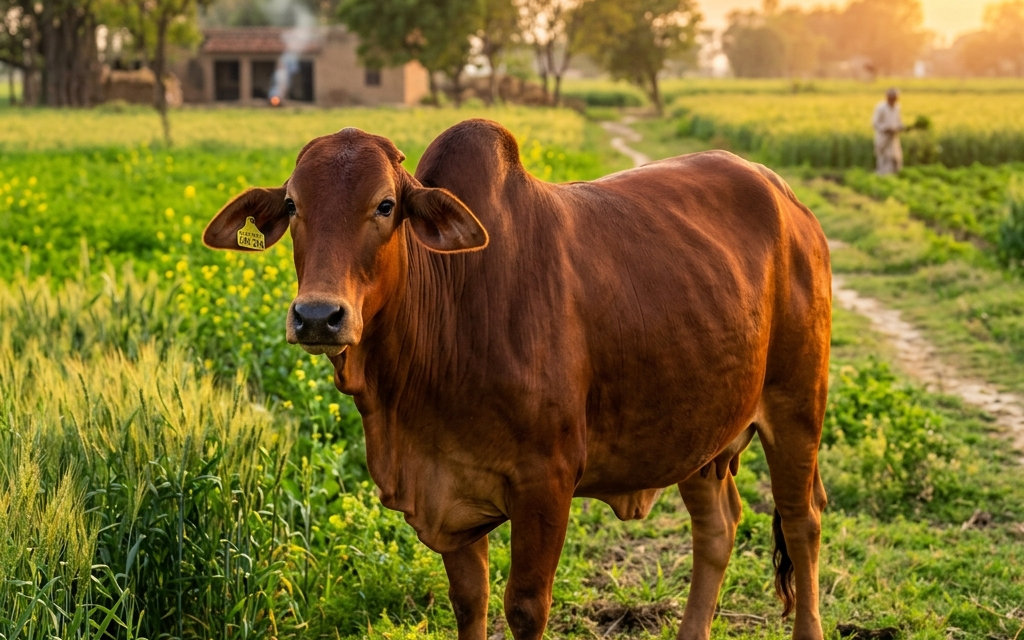
The breed takes its name from a pastoral tribe called the Raths — Muslims of Rajput extraction who lead a nomadic life. Rathi cattle are believed to have originated from a mixture of Sahiwal, Red Sindhi, Tharparkar, and Dhanni breeds, with a predominance of Sahiwal blood. Animals are of medium size with a symmetrical body and short, smooth coat. The colour is generally brown with white patches all over the body, though completely brown animals and those with black coats and white patches are also found.
On average, Rathi cows yield 5 to 10 litres of milk per day, with a lactation milk yield ranging from 1,500 to 3,000 kg. In rare instances, exceptional individuals have produced 15 to 20 litres per day. The Rathi is locally called “Rajasthan ki Kamadhenu” — the cow that fulfills all needs. Recognizing its potential, the National Dairy Development Board initiated a Rathi breed conservation and development programme in Bikaner and Shri Ganganagar districts since 2002.
2. Nagori — The Trotting Titan
While the Rathi reigns in milk, the Nagori rules in movement. This is Rajasthan’s great working cow — a breed built not for the dairy shed but for the open road, the ploughed field, and the deep well.
The breeding tract of the Nagori breed is Bikaner, Jodhpur, and Nagaur district of Rajasthan. The breed takes its name from the Nagaur district, its home tract. Nagori cattle are fine, big, upstanding, active, and docile — white in colour with a long, narrow face like that of a horse. They have long, deep, and powerful frames with straight backs and well-developed quarters.
The Nagori breed is a draught breed, mainly used for agricultural purposes such as ploughing, cultivation, drawing water from wells, and transportation of field produce to markets. It is also famous as a trotter — harnessed to light iron-wheeled carts for quick transportation all over Rajputana.
Average milk yield per lactation of Nagori cattle is 603 kg, with an average milk fat of 5.8%. The lactation yield ranges from 479 to 905 kg. The Nagori is not a milch breed — her cows give modestly while her bulls carry the weight of Rajasthan’s farms. In a region where mechanical power arrived late, the Nagori bullock was the engine that fed entire communities.
3. Tharparkar — The White Desert Queen
Tharparkar is a dual-purpose and disease-resistant cattle breed named after the Thar Desert in Rajasthan. The breed is also known as “White Sindhi”, “Grey Sindhi”, and “Thari” based on its actual origin in Sind, Pakistan. The breeding tract includes the Kutch district of Gujarat and the Barmer, Jaisalmer, and Jodhpur districts of Rajasthan.
The Tharparkar’s appearance is immediately striking. These cattle have a medium to large build with white to silver-grey coats. Their faces and extremities are darker than the rest of their bodies, and the colour of the coat actually darkens during winter — a unique adaptation to seasonal temperature shifts. They have a broad forehead, medium-sized horns that curve upward and outward, and large, semi-pendulous ears.
What makes the Tharparkar truly extraordinary is her ability to produce milk even when there is almost nothing to eat. The animals can thrive on small bushy vegetation such as Sewan grass during drought and fodder scarcity conditions, and still produce a reasonable amount of milk, with an average yield of 1,749 kilograms per lactation, ranging from 913 to 2,147 kg. Under farm conditions with good nutrition, animals have produced over 3,000 litres per lactation. The Tharparkar milk contains an average of 4.4% fat and 9.0% SNF (Solid Not Fat), and is A2 beta-casein protein milk — increasingly sought after for its nutritional and digestive properties. Among indigenous breeds, the Tharparkar holds the distinction of having the highest disease resistance and is the highest milk-producing cow native to Rajasthan.
4. Sahiwal — The Queen of Indian Milch Breeds
Of the seven breeds in Rajasthan, the Sahiwal stands apart as the single finest milch cow on the Indian subcontinent — a distinction recognized internationally, with the breed now found in over a dozen countries across Africa, Asia, and Oceania.
Sahiwal is considered to be one of the best milch cattle breeds of India. The breed derives its name from the Sahiwal area in Montgomery district of Punjab in Pakistan. These animals are also known as “Lambi Bar”, “Lola”, “Montgomery”, “Multani”, and “Teli”. The breeding tract in Rajasthan is concentrated in the Sri Ganganagar district. The cows are brownish red in colour, with shades varying from mahogany red-brown to greyish red. They have well-developed udders, good slope at rump, and shorter horns. Average lactation yield is 2,325 kilograms.
Sahiwal cows are renowned for their exceptional milk production capabilities. On average, they produce between 2,000 to 3,000 kilograms of milk per lactation cycle, with some exceptional individuals producing even more. The milk is characterized by its rich flavour and creamy texture, with a high butterfat content of typically 4.5% to 5.5%. The Sahiwal is also disease resistant, heat tolerant, and notably calm in temperament — a breed that gives generously and asks for little. In Rajasthan, she is the preferred choice for serious dairy farmers in the northern districts.
5. Kankrej — The Ancient Giant
The Kankrej is one of the oldest and heaviest cattle breeds in India, and her story stretches back to the Indus Valley Civilization itself. Archaeologists studying Harappan seals have identified bull figures widely believed to represent the male Kankrej — meaning this breed has walked the land of northwestern India for at least 4,000 years.
The Kankrej cow is found in the Rann of Kutch in Gujarat and the Barmer and Jodhpur districts of Rajasthan. It is also known as Wadad, Waged, and Wadhiar. It is used for both dairy and draught purposes. Kankrej cow colour is a distinct silver-grey to iron grey, with a prominent hump and lyre-shaped horns.
The Kankrej breed takes its name from the Kankrej Taluka in Gujarat. It is one of the heaviest of the Indian breeds of cattle. Significant characteristics include resistance to tick fever, heat stress, very little incidence of contagious abortion and tuberculosis — qualities that made the Kankrej a very popular breed for export and breeding in foreign countries. The cows yield on average 1,738 kilograms of milk per single lactation. It was the Kankrej, along with the Gir, that was taken to the United States to develop the American Brahman — one of the most widely used beef breeds globally. Kankrej is India’s heaviest cow breed, known for its “Sawai Chal” — a fast, distinctive gait. In Rajasthan’s Jodhpur and Barmer regions, Kankrej bullocks are prized above all others for their power and speed.
6. Nari — The Hill Wanderer
The Nari is perhaps the least known of Rajasthan’s deshi breeds, yet she represents a remarkable ecological niche — the indigenous cow adapted not to the flat desert but to the rugged foothills of the Aravallis.
The breeding tract of the Nari includes the Pali and Sirohi districts of Rajasthan and the Banaskantha and Sabarkantha districts of Gujarat. The majority of the Nari cattle population is found surrounding the Aravali forest range. These regions are slightly hilly and undulating. The animals are adapted to the hot climate in the areas of foothills of the Aravalli. Coat colour varies from white or greyish-white in the majority of animals; bulls are either white, greyish-white, or black. Animals are medium in size. Horns are spirally curved and outward or forward in orientation, long and thick at the base and pointed at tips. The forehead is broad and slightly concave.
The name “Nari” is derived from the word “Nar”, meaning hills. The breed is also known as “Sirohi”. These are medium-sized animals with excellent migratory capacity and can survive well on grazing and in open housing during all kinds of weather. Average lactation yield is 1,647 kg. The Nari is valued for her excellent draught power across both plains and hilly forest terrain — a dual-purpose animal ideally suited to the transitional landscape where desert meets mountain. She is a breed under threat, with a population estimated at around 15,000, making conservation efforts particularly urgent.
7. Mewati — The Workhorse of Eastern Rajasthan
The Mewati completes Rajasthan’s bovine family from the east — a powerful, docile dual-purpose breed whose home lies in the fertile but demanding borderlands where Rajasthan meets Haryana and Uttar Pradesh.
Mewati, also known as “Kosi” or “Mehwati”, is a draught-purpose breed. The breeding tract includes Alwar and Bharatpur districts of Rajasthan, Gurgaon and Faridabad districts of Haryana, and Mathura district of Uttar Pradesh. Mewati cattle are powerful and docile, useful for heavy ploughing, carting, and drawing water from deep wells. They are similar to the Hariana breed but show traces of influence from Gir, Kankrej, and Malvi breeds. Mewati cattle are usually white with neck, shoulders, and quarters of a darker shade. Horns are small to medium in size. The face is long and narrow with a slightly bulging forehead. Average lactation yield is around 958 kg.
The Mewati are generally sturdy, powerful, and docile. The bulls are known for their strength and endurance and are hence used for agricultural and carting purposes as well as for drawing water from deep wells. The Mewati is the farmer’s companion in eastern Rajasthan — not the star of the dairy yard, but the reliable, unassuming backbone of rural agriculture. Like many Indian draught breeds, her population has declined sharply with mechanization, making her a breed in urgent need of recognition and protection.
The Living Legacy
Across these seven breeds, a pattern emerges that is at once ecological, cultural, and spiritual. Each breed was shaped by the land it inhabits: the Rathi by the deep desert’s demand for milk under stress; the Nagori by Rajputana’s need for speed and transport; the Tharparkar by the existential scarcity of the Thar; the Sahiwal by the agricultural richness of the canal-fed northwest; the Kankrej by millennia of civilizational continuity; the Nari by the hilly terrain of the Aravallis; the Mewati by the hard-working borderlands of the east.
Together, they represent something no crossbred, no Holstein, no imported exotic strain can replicate: thousands of years of co-evolution between the people of Rajasthan and the animals they depended upon — animals who, in the language of the Vedas, were never merely livestock but *Gaumata*, the mother of civilization itself.
To preserve these breeds is not nostalgia. It is nutrition, ecology, culture, and wisdom — all walking on four legs, in the dust and sun of the world’s most extraordinary desert state.
Sources: Dairy Knowledge Portal (ICAR) | National Dairy Development Board (NDDB) | Save Indian Cows / Surabhivana Gaushala | Wikipedia Indigenous Cattle Breeds of India | ICAR-NBAGR breed registrations | ResearchGate — “Rathi Cattle of North-West of Rajasthan: A Gift of Nature” | Journal of Agricultural Science and Technology