
Madhya Pradesh’s Four Deshi Cows: Malvi, Nimari, Gaolao, and Kenkatha
Madhya Pradesh sits at the geographical heart of India — and its four indigenous cow breeds reflect the remarkable diversity of that central position. The Malwa plateau, the Narmada valley, the forests of Gondwana, and the rocky Bundelkhand terrain have each produced a distinct deshi breed, shaped by the specific land, climate, and people it served for generations. These are not glamorous breeds celebrated in national headlines. They are working animals — honest, hardy, and quietly essential to the rural economy of India’s largest state.
1. Malvi — The Lord of the Malwa Plateau
Malvi is named after its place of origin — the Malwa region. It is also known by the synonyms “Mahadeopuri” and “Manthani”. The breeding tract includes Rajgarh, Shajapur, Ratlam, and Ujjain districts of Madhya Pradesh.
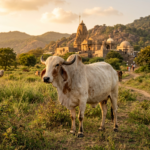
The Malvi is primarily a draught breed, and her bullocks are her greatest offering to the world. Malvi cattle are white or whitish-grey, darker in males, with the neck, shoulders, hump, and quarters almost black. Cows and bullocks become nearly pure white with age. The horns are curved, emerging from the outer angle of the poll in an outward and upward direction, about 20 to 25 cm long. The animals are well known for quick transportation, endurance, and the ability to carry heavy loads on rough roads. The animals of this breed are strong and well-built.
The average milk yield in this breed is around 916 kg per lactation with 4.3% fat, ranging from 627 kg to 1,227 kg. Milk production is modest — the Malvi was never bred for the dairy shed. She was bred for the road: for the ancient trade routes that crossed the Malwa plateau carrying cotton, grain, and goods between the coasts. Her bullocks are renowned for covering long distances at speed without fatigue. In the pre-mechanization era, the Malvi bullock was the freight engine of central India’s commerce. The breed has been studied at the Government Cattle Breeding Farm at Agar in Shajapur district of Madhya Pradesh for more than 50 years — a testament to the sustained scientific recognition of her agricultural value.
2. Nimari — The Narmada’s Copper-Coloured Child
Of the four MP breeds, the Nimari is perhaps the most visually distinctive. She carries the genetic legacy of two of India’s greatest breeds — the Gir of Gujarat and the Khillari of Maharashtra — merged along the sacred banks of the Narmada into something entirely her own.
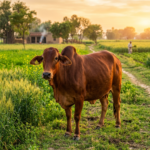
Nimari, also known as “Khargaon”, “Khargoni”, and “Khurgoni”, is a prominent draught breed of central India named after its place of origin in the Nimar region of Madhya Pradesh. Its breeding tract comprises Khargaon (West Nimar) and Badwani districts. Believed to have originated from crossing of Gir and Khillari breeds, it inherits the characteristics of both — it is red in colour with large white splashes and possesses a massive body, a convex forehead, and horns that resemble the Gir breed. Hardiness, agility, and temper have been inherited from the Khillari.
The Nimari cattle are brownish-red, copper in colour, with white patches giving a spotted appearance. This copper coat with white splashing is genuinely striking — she looks unlike almost any other deshi cow in India. Prized primarily for draught work, Nimari animals are maintained chiefly for agricultural operations with occasional use in transportation. Nimari bullocks are known for their draught work, but cows are poor milkers. The Gir blood gives her the bone and presence of a large dairy animal; the Khillari blood gives her the fire and hardness of a hill draught breed. Together, they produce an animal built for the Narmada valley’s demanding agricultural terrain — powerful, alert, and fiercely capable on both rough ground and open field.
3. Gaolao — The Maratha War Breed Turned Farmer
The Gaolao carries a history unlike any other breed in this list. She was not bred by farmers for farming — she was bred by warriors for war.
According to historical accounts, the Marathas developed the Gaolao breed into a fast-trotting type suitable for swift military transport in the hilly regions of Gondwana, Madhya Pradesh. Initially utilised for military purposes by the Maratha army during their invasion of the local Gond Kingdom, the breed was known to have decent milk-producing capacity in the past. However, in the last two centuries, selective breeding has mainly focused on developing its draught capacity.
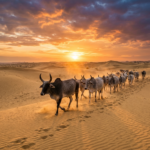
The Gaolao cattle breed is mainly found in Wardha district in Maharashtra, Balaghat and Chhindwara districts in Madhya Pradesh, and Rajnandgaon district in Chhattisgarh. The Gaolao cattle are short-horned, white or light grey, with a long octagonal-shaped skull, not-prominent orbital arches, and a slightly convex face in profile. There is a marked resemblance to the Ongole breed of Andhra Pradesh — large-framed and powerful — but the Gaolao is lighter and more agile, built for speed over sheer mass. Gaolao cows produce 5 to 6 litres of milk per day. The average daily milk yield is 2.9 kg and lactation milk yield is 540 kg.
Unfortunately, the Gaolao breed has faced challenges due to government policies supporting crossbreeding programmes and castration drives, leading to a significant decrease in genetic diversity and population. Efforts to protect the breed include artificial insemination and community-based conservation practices. A breed that once helped the Marathas move armies across the Deccan now struggles to survive the march of indifference.
4. Kenkatha — The River-Named Bull of Bundelkhand
The Kenkatha gets her name from the River Ken — the tributary of the Yamuna that flows through the rocky, forested highlands of Bundelkhand, separating Madhya Pradesh from Uttar Pradesh. She is, in essence, named after her geography, shaped by its harshness, and surviving because of its demands.
The Kenkatha, also known as the Kenwariya, originated in the provinces of Bundelkhand in Uttar Pradesh, along the banks of the River Ken and the Vindhya ranges in Madhya Pradesh. The breeding tract lies along the banks of the River Ken in the Panna and Tikamgarh districts of Madhya Pradesh, and the Chhatarpur, Lalitpur, Banda, and Hamirpur districts of Uttar Pradesh.
The Kenwariya cattle are small, sturdy, and fairly powerful, varying in colour from grey on the barrel to dark grey on the rest of the body. The head is short and broad, and the forehead is dished. Horns emerge from the outer angles of the poll in a markedly forward direction and terminate in sharp points. The ears are sharply pointed and do not droop. The body is short, deep, and compact. The back is straight but the quarters are drooping. The limbs are short but powerful, and the feet are hard. The hump is well developed.
During the lactation period, the Kenkatha cow produces 500 to 600 litres of milk. They are popular for their ability to survive on scarce fodder. The Kenkatha cattle breed produces A2 milk with high butterfat content, making it rich and creamy, and is often used in traditional dairy products. These cattle require minimal maintenance and can graze on sparse vegetation, making them ideal for regions with limited fodder.
The Kenkatha is Bundelkhand personified — small, hard, unbreakable. In a region where water is scarce and the land is rocky and ungenerous, she does not merely survive; she works. Her bulls are the draught power of some of India’s most difficult farming terrain. The Kenkatha breed of cattle has been interbreeding with other non-descript cattle without restriction, leading to a rapid decline in its population, and immediate steps are needed for conservation.
Four Breeds, One Heartland
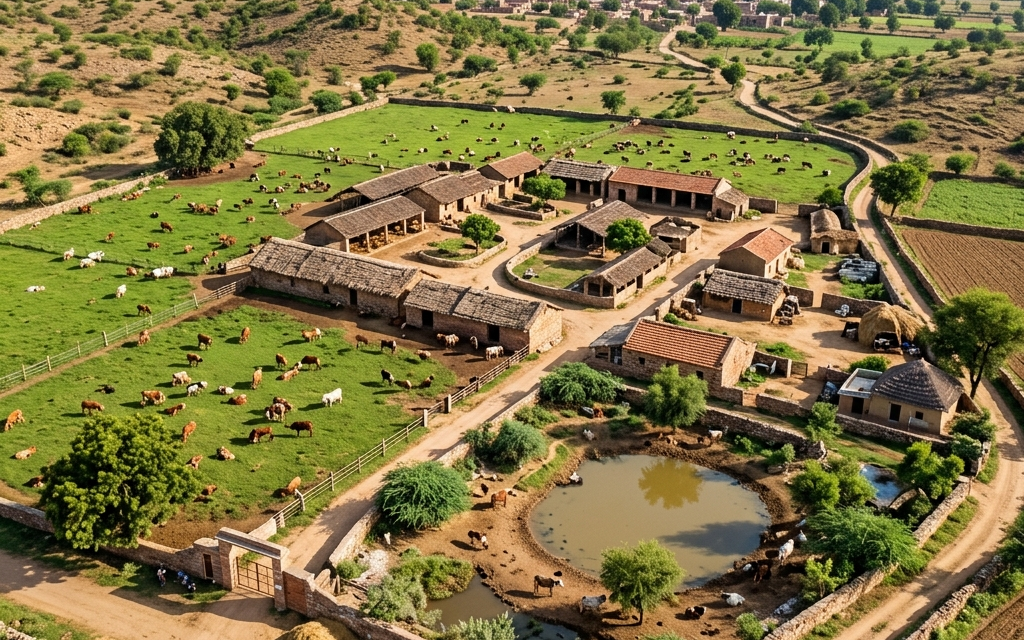
The Malvi of Malwa, the Nimari of the Narmada valley, the Gaolao of the Gondwana forests, and the Kenkatha of the Vindhyan Bundelkhand — together they map the agricultural soul of Madhya Pradesh. None of them are high-yielding dairy stars. All of them are something rarer and more important: perfectly adapted, disease-resistant, low-maintenance deshi cows whose genes carry centuries of relationship with a specific soil, a specific climate, and a specific farming community.
To preserve them is not sentiment. It is ecological intelligence.
Sources: Dairy Knowledge Portal (ICAR) | CowPedia — Indigenous Breeds of India | SwadeshiVIP Breed Profiles | Gaon Connection — *Cows of Madhya Pradesh* | Pashudhan & Animal Science — *Cattle Breeds of Madhya Pradesh*